The character chronicle
Altan
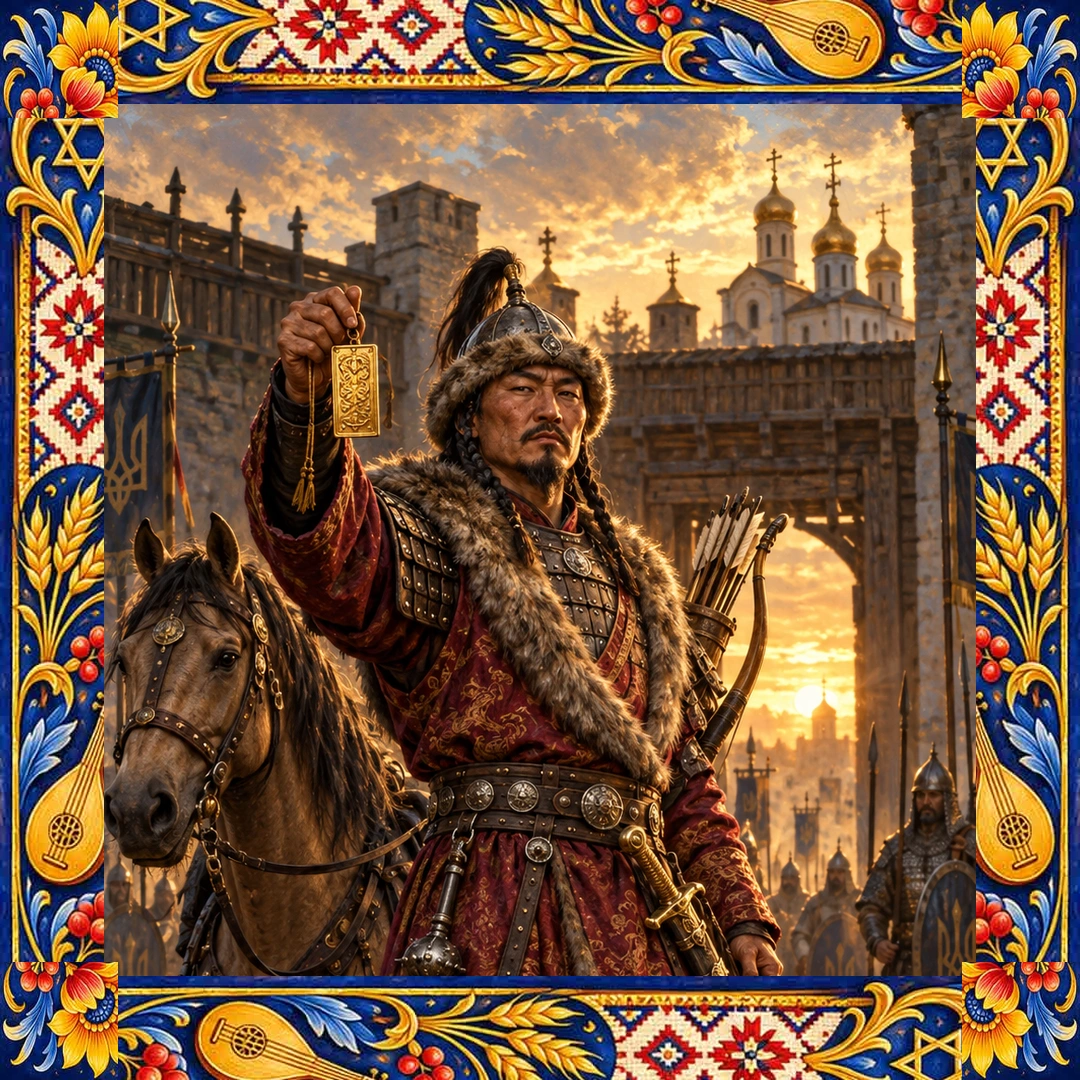
The voice before the storm. Batu's envoy.
"Batu does not need to come himself."
IN THE STORY
Batu does not need to come himself.
Altan carries the demand into Kyiv: submit and pay. He speaks for the power gathering beyond the gates. The man who delivers the message is close enough to answer. The man behind it is not.
He arrives alone, with one horse, one tablet, and no army. He does not need an army. The tablet is the army. The tablet says: I speak for Batu Khan. What you do to me, you do to him.
And everyone in Kyiv knows what that means.
THE MAN BEHIND THE MESSAGE
A name of his own. Another man's authority.
Altan is not Batu. He is the envoy who must stand in front of the people Batu threatens. The tablet gives his words weight. It does not make him the man who decides what happens next.
He is a professional. He has delivered this message to a dozen cities. He knows which cities paid, which cities fought, and what happened to each. He does not threaten. He does not need to. He just delivers the words, and waits.
But he is also a man. He has a name — Altan, "golden" — he has a horse he cares for, he has seen what happens when a city says no. He remembers the cities that said no. He does not want to remember Kyiv that way.
That is his tragedy: He likes the cities he has to threaten. And he has to threaten them anyway.
THE HISTORY BEHIND THE ROLE
A fictional man inside a real invasion.
Batu Khan and the Mongol capture of Kyiv in 1240 belong to history. Altan is Golden Gates' fictional envoy. His name, words and encounters belong to the show, not to the biography of a documented messenger.
This matters because it gives you freedom: Altan can change. Altan can doubt. Altan can return with a different message. Batu cannot change — he is history. Altan can — he is story.
THE SECRET HE CARRIES
He has delivered this message before. And he remembers the answers.
Altan has a ledger in his head. Not a written one — a memory one. City by city. Who paid. Who fought. Who lived. Who did not.
He does not tell Kyiv this. He just holds up the tablet and says: "Submit and pay."
But when he is alone at night, back in camp, he thinks about the cities that said no. He thinks about the mothers, the bakers, the boys with spears. He thinks about Kyiv — the gold domes, the market, the girl who makes bread, the old man who watches the hearth — and he wonders if this time will be different.
He cannot say this to Mikhail. He cannot say this to Batu. He can only say it to his horse. And his horse does not answer.
HIS WORLD
He can return. The message can change.
Batu remains the distant threat. Altan gives that threat a face the audience can recognize when it comes back. A new visit means the court must listen again, and decide whether anything has changed.
First visit: "Submit and pay." Second visit: "Have you decided?" Third visit: "You have run out of time."
Every time Altan returns, the tension goes up. He is the show's countdown, on horseback.
WHY HE MATTERS
Someone has to carry the answer back.
A threat on the horizon can be ignored. A man standing at the gates cannot. Altan makes the distance between Batu's camp and Mikhail's court feel very short.
He is also the only bridge between two worlds. Mikhail cannot talk to Batu. Batu will not talk to Mikhail. Altan talks to both. He is the only man who understands both sides. And that means he is the only man who knows how close Kyiv is to disaster.
RELATED CHARACTERS
Batu Khan · Mikhail · Sergei · Dobrynya · Baruch